AI and creativity
How should brands use AI in creative production?
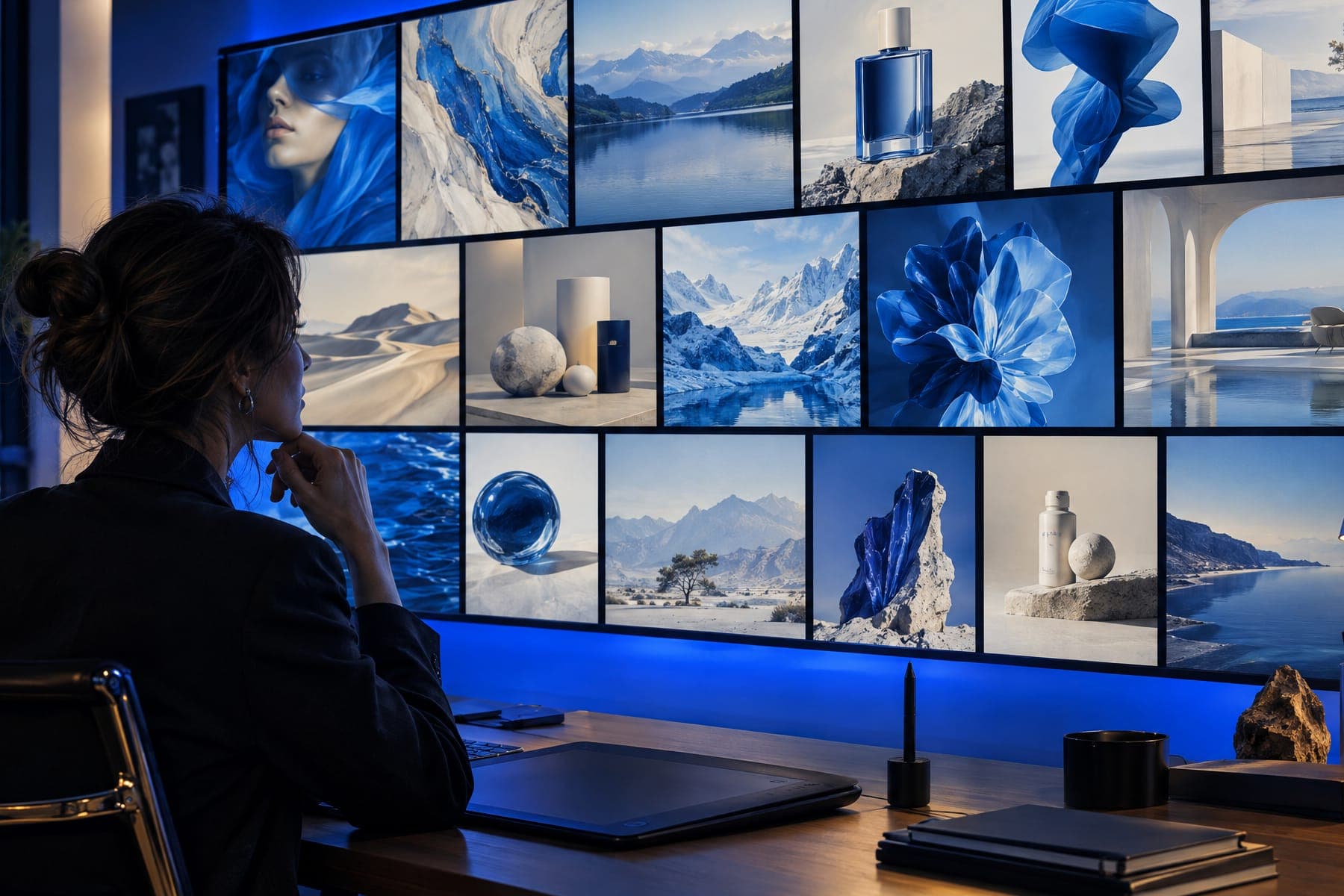
Brands should use AI as a lens, not as the look. It earns its place early in production: exploring more routes, prototyping and visualising ideas before money is committed, testing options, and versioning approved work. It should never replace the idea, human judgement, real casting, native Arabic writing or final typography. The audience should notice the idea, not the tool.
What does it mean to treat AI as a lens?
A lens changes what a filmmaker can see and how fast they can see it. It does not decide what the film is about. That is the right role for AI in creative work. It helps a team explore faster, prototype and visualise earlier, and test more routes before anyone commits budget. It does not supply the idea, and it should not supply the look.
The opposite approach is easy to spot. Work that leads with the tool tends to share the same visual habits: glossy surfaces, perfect skin, blue gradients, chrome and glowing circuits. It reads as made with AI before it reads as your brand. When the audience notices the tool first, the brand has paid for someone else's aesthetic.
At AI-DARE, this is a working rule written into our brand book: the idea comes first and the technology serves the idea. Nobody buys a film for the lens. So we judge AI-assisted work by the same questions as any other work. Does it have an idea? Would we recognise it without the logo? Would it make someone stop?
Where does AI genuinely help in creative production?
AI is most useful in the part of a project where uncertainty is highest and spending is lowest: the early stages. Before a shoot is booked or a campaign is printed, a team can turn a written idea into something a client can see, react to and argue with. That changes the quality of decisions, because people respond to images and motion more honestly than to paragraphs in a deck.
It is also useful at the other end, once a route is approved and has to be adapted for many formats, sizes and markets. Here the value is efficiency, and a person still checks every output against the approved master.
Between those two points, in the core production, the human crew, cast, designers and writers still carry the work. AI supports them. It does not stand in for them.
- Explore: generate many visual territories for one idea in days, then discard most of them quickly.
- Prototype: build moodboards, style frames, rough animatics and previz so the client sees the brave route before it is produced.
- Test: put two or three routes in front of real people or internal reviewers before committing the budget to one.
- Plan production: use previz to block shots, test locations and lighting, and catch problems before the shoot day.
- Version: adapt approved assets across formats and placements, with a person checking every frame.
- Draft localisation notes: produce rough starting points that native writers then rewrite completely.
What should AI never replace?
Some parts of creative work carry the brand's judgement and accountability. Handing them to a model removes the reason a client hires a creative partner in the first place. These are the parts we keep human, every time.
Arabic deserves its own note. A line that works in English often needs a completely different idea in Arabic. Machine output can be grammatical and still sound translated, flat or culturally off for a Gulf reader. Brand Arabic should be written by native writers and reviewed natively before it is published, the same standard you would apply to an English headline.
Type is the other hard line. Image models still render letters unreliably, and they cannot be trusted with a logo or a pack. Our production rule is simple: generated imagery never carries text, logos or packaging. Wordmarks, typography and Arabic are always set in code or composited afterwards, so they stay exactly as approved.
- The idea. A model remixes what already exists. Deciding what a brand should say, and why now, is a human call.
- Judgement and taste. Choosing one route out of fifty is the creative director's job.
- Real people. When a campaign shows a face, cast a real person with consent, not a generated one.
- Native Arabic writing. Written, not translated, and reviewed by a native speaker.
- Final typography, logos and packaging. Set or composited by designers, never generated.
- Accountability. A named person signs off every asset that goes public.
How do you avoid generic AI visuals?
Generic AI imagery comes from generic prompts and no art direction. The model reaches for its averages: symmetrical faces, polished surfaces, dramatic lighting that belongs to no particular place. The fix is the same as in any production. Start from a brief that defines the brand's world, its light, materials, casting and grade, and judge every output against it.
A practical test: cover the logo and ask whether the image could belong to any other brand in your category. If the answer is yes, it is not finished. Brands in Qatar and across the GCC face a second test. Regional relevance does not come from dunes, dhows or gold calligraphy. It comes from knowing the culture well enough to skip the cliché.
In practice, attach a short refuse list to every AI-assisted brief. Ours includes robots, chrome, holograms, neural networks and glowing circuits, generic blue tech gradients, digital brains as decoration and fake-perfect generated faces. If an output contains any of these, it does not reach the client.
What about rights, consent and disclosure?
AI-assisted work raises questions that a traditional shoot handles through contracts and releases. Who owns the output? Was any reference material used with permission? Does anyone recognisable appear, and did they agree? The rules differ between platforms, tools and jurisdictions, and they continue to change, so treat this as a list of questions to settle with your own legal advisers, not as legal advice.
Three habits reduce risk. First, know which tools are used at each stage and read their commercial terms. Second, never feed a model a real person's likeness or voice, or a third party's protected work, without clear permission. Third, keep a simple record of what was generated, what was edited by hand and what was shot or drawn by people.
On disclosure, be honest by default. Some platforms ask advertisers to label realistic synthetic media, and audiences in the region are increasingly aware of it. If an image would mislead someone about a real event, product or person, it should not be made. If AI shaped the final asset in a meaningful way, agree with the client up front how and where that is acknowledged.
What does a sound AI-assisted workflow look like?
The workflow below keeps AI where it adds speed and keeps people where they add judgement. It suits campaigns, brand films and identity work alike. The order matters: idea before tool, approval before production, human craft for anything final.
This is how our promise works in practice: “We carry the risk. You take it.” The studio absorbs the creative risk of exploring and prototyping the brave version, so the client sees it before deciding. It is not a guarantee of commercial results. It is a commitment that the brave route was explored properly before anyone had to commit to it.
- 1. Brief: define the dare, the audience, the brand world and the refuse list in plain words.
- 2. Idea: the creative team writes the concept before any model is opened.
- 3. Explore: generate broad visual territories quickly, then cut hard to two or three.
- 4. Prototype: build style frames, animatics or previz for each surviving route.
- 5. Test: review routes with the client and, where useful, with a small group from the real audience.
- 6. Decide: one recommendation, argued and approved in writing.
- 7. Produce: shoot, design, write and animate with human crews, using AI for clean-up, extension and versioning where it is faster.
- 8. Finish: set all type, logos and Arabic in code or composite, run native Arabic review, and have a named person approve each asset.
What should brands ask before commissioning AI-assisted work?
If you are briefing an agency or studio that uses AI, these questions separate a considered process from a shortcut. Ask them in the first meeting, and expect clear, specific answers rather than general reassurance.
A partner who answers these well is using AI to show you more options sooner and to make the final work sharper. A partner who cannot answer them is using AI to cut corners, and the audience will usually notice.
- Where in the process will AI be used, and where will it not?
- Who writes the idea, and who makes the final creative decisions?
- Which tools are used, and have their commercial terms been checked for this use?
- How are real people's likeness and voice handled, and how is consent recorded?
- Who writes and reviews the Arabic copy?
- How are logos, type and packaging produced in final assets?
- How will you keep the work from looking like generic AI imagery?
- What record of generated, edited and original material will we receive at handover?