App developmentDare to go first.

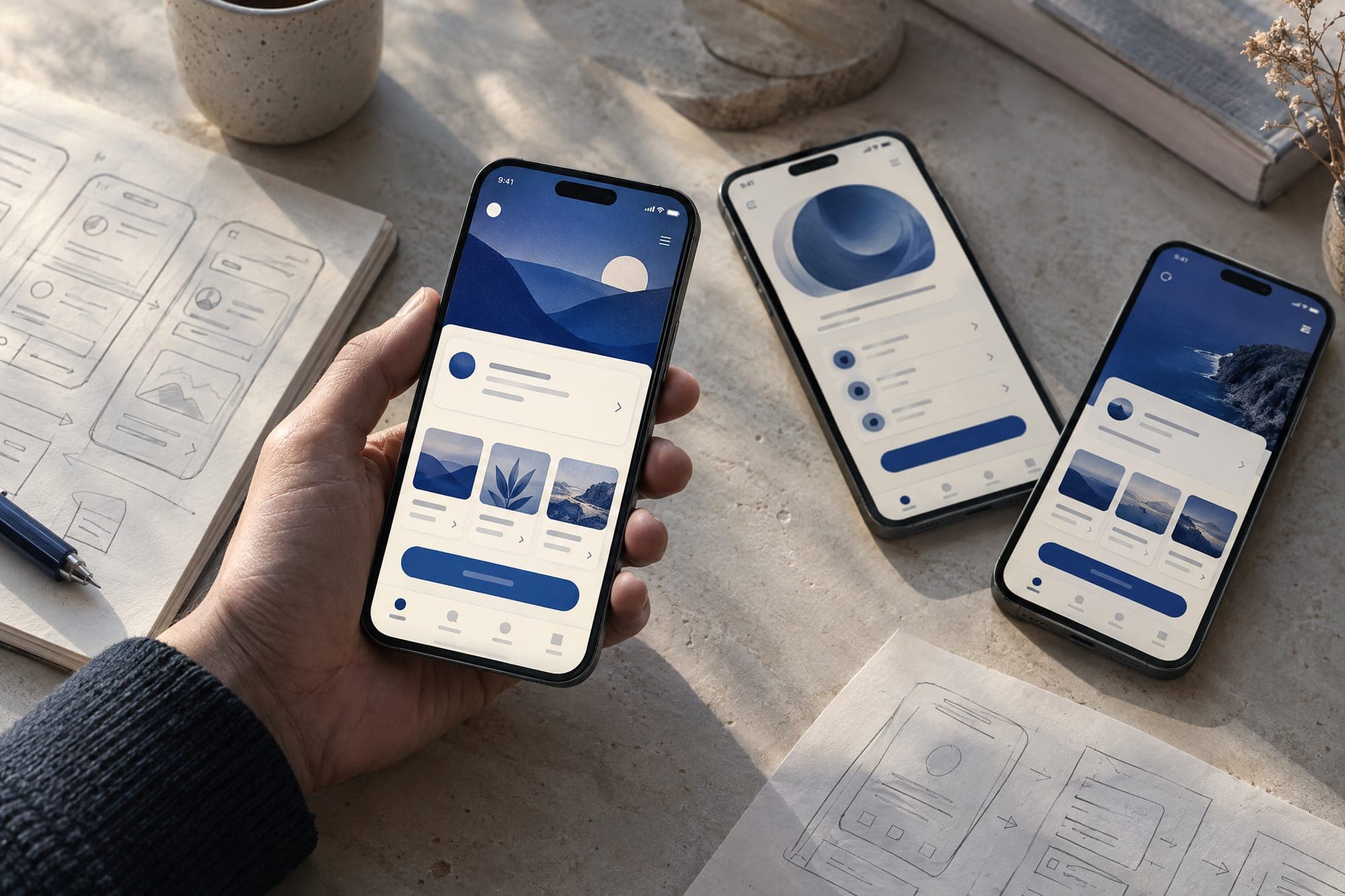
Mobile app screens in Arabic and English being reviewed on phones in a design session

What is App development at AI-DARE?

AI-DARE's app development service designs and builds mobile and web apps for companies in Qatar and the GCC, covering product strategy, UX research, UI design, development and launch on iOS, Android and the web. Every app is bilingual, with Arabic designed right to left as a first language rather than a translated layer.

What you get

  • Product discovery: users, the core job the app does, feature priorities and a scoped first release
  • UX flows and clickable prototypes tested with real users before development
  • A bilingual UI design system with full right-to-left mirroring for Arabic
  • iOS, Android and web app development, with integrations to your existing systems
  • App store submission, analytics, crash monitoring and a roadmap for the releases after launch

How it moves

  1. 01

    Discover

    We pin down the one job your app must do better than anything else, who it is for, and what the smallest useful first release looks like. Everything else goes on the roadmap.

  2. 02

    Prototype

    We design the key flows in Arabic and English and turn them into a clickable prototype. Real users try it on their phones, and we fix what confuses them while changes are still cheap.

  3. 03

    Build

    Development runs in short cycles with a working build you can test every step of the way. Integrations, security and performance are handled from the first sprint, not at the end.

  4. 04

    Launch and iterate

    We prepare store listings in both languages, manage submission and review, then read the data from real use to plan what the next release should change.

How do you build a successful app in Qatar?

Build an app around one task people already need to do, and make that task faster than any alternative, including a website or a WhatsApp message. Launch the smallest version that does it well in Arabic and English, measure how people use it, then grow it. Feature-heavy first releases are the most common reason apps stall.

In the Gulf, WhatsApp is often the real competitor. Customers already book, order and ask questions there. An app earns its place on the home screen only when it saves time, remembers preferences or gives access that a chat cannot.

We test with real users in the market early, including Arabic-first users, because assumptions made in a meeting room rarely survive the first five minutes of real use.

What makes a bilingual Arabic and English app different?

A bilingual app has to mirror its whole interface for Arabic, not just translate the words. Navigation, swipe gestures, progress indicators and directional icons reverse, while media controls, phone numbers and some charts stay left to right. Mixed Arabic and English text, dates, Hijri calendar needs and Arabic input all need deliberate design and testing.

Arabic text runs longer or shorter than English depending on the phrase, so buttons and labels must flex without breaking. Arabic also needs a typeface that renders well at small sizes on both iOS and Android.

Users should be able to switch language inside the app without reinstalling or losing their place, and notifications, emails and SMS should follow the language they chose.

Native or cross-platform: which is right for my app?

For most business apps, a cross-platform framework such as React Native or Flutter is the right choice: one codebase, consistent bilingual behaviour on iOS and Android, and faster updates. Native development makes sense when the app depends on heavy device features, complex animation or maximum performance. We recommend after the discovery phase, based on your features.

Sometimes the honest answer is a web app. If your users need the service occasionally and do not want another download, a fast, installable web app can reach them through a link and still feel like an app.

Whatever the choice, the backend, API and admin dashboard matter as much as the screens. We design them together so your team can manage content, users and orders without developer help.

What should we plan for after the app launches?

Plan for a product, not a project. After launch an app needs analytics to see where people drop off, updates for new iOS and Android versions, responses to store reviews, security patches and a roadmap of improvements. Budget and team time for this from day one, because an app that stops changing starts losing users.

Growth matters as much as code. Store listings in Arabic and English, screenshots that show the real value, and campaigns that explain why to download are part of launch planning.

We agree success measures before launch, such as activation, repeat use and completed bookings or orders, and review them with you on a regular rhythm.

Questions, answered.

What affects the cost and timeline of building an app?

The number of features and user roles, the platforms (iOS, Android, web), integrations with payment gateways, CRM or ERP systems, the admin dashboard, and the level of custom design and animation. A tightly scoped first release costs less and launches sooner. We estimate after discovery, when the scope is clear enough to price honestly.

Can the app connect to our existing systems?

Usually, yes. We integrate with booking engines, POS, CRM, ERP, loyalty programmes, payment gateways and messaging services through their APIs. Where the business is eligible, apps can also use national digital identity services, such as UAE Pass in the UAE or Nafath in Saudi Arabia, for verified sign-in. We review each system's documentation during discovery.

Do you publish the app on the App Store and Google Play?

Yes. We prepare the store listings, screenshots and privacy details in Arabic and English and manage submission and review. The app is published under your own developer accounts, so you own the listing and its reviews. If your audience needs it, we can also prepare builds for other stores such as Huawei AppGallery.

Can you take over an app another company built?

Often, yes. We start with a technical audit of the code, architecture, dependencies, security and store accounts, then tell you plainly whether to keep improving it or rebuild parts of it. You need access to the source code repository and accounts for that, so check your current contract for ownership terms first.

Should we build an app or a website first?

For most businesses, a strong mobile website comes first because it is found through search and shared through links. An app makes sense when customers return often, need to be logged in, or benefit from notifications, offline access or device features. If you are unsure, we will tell you which one earns its cost first.

How do you protect user data in the app?

We collect only the data the app needs, encrypt it in transit and at rest, use secure authentication and keep permissions to a minimum. Privacy notices and consent flows are written in both languages. Qatar's personal data protection law and equivalent laws in other GCC markets apply, so we implement the requirements your legal adviser confirms.

Your safe idea has already been made.

Tell us the other one. A human replies on WhatsApp, fast, with one question back.