Web design and developmentDare to build.

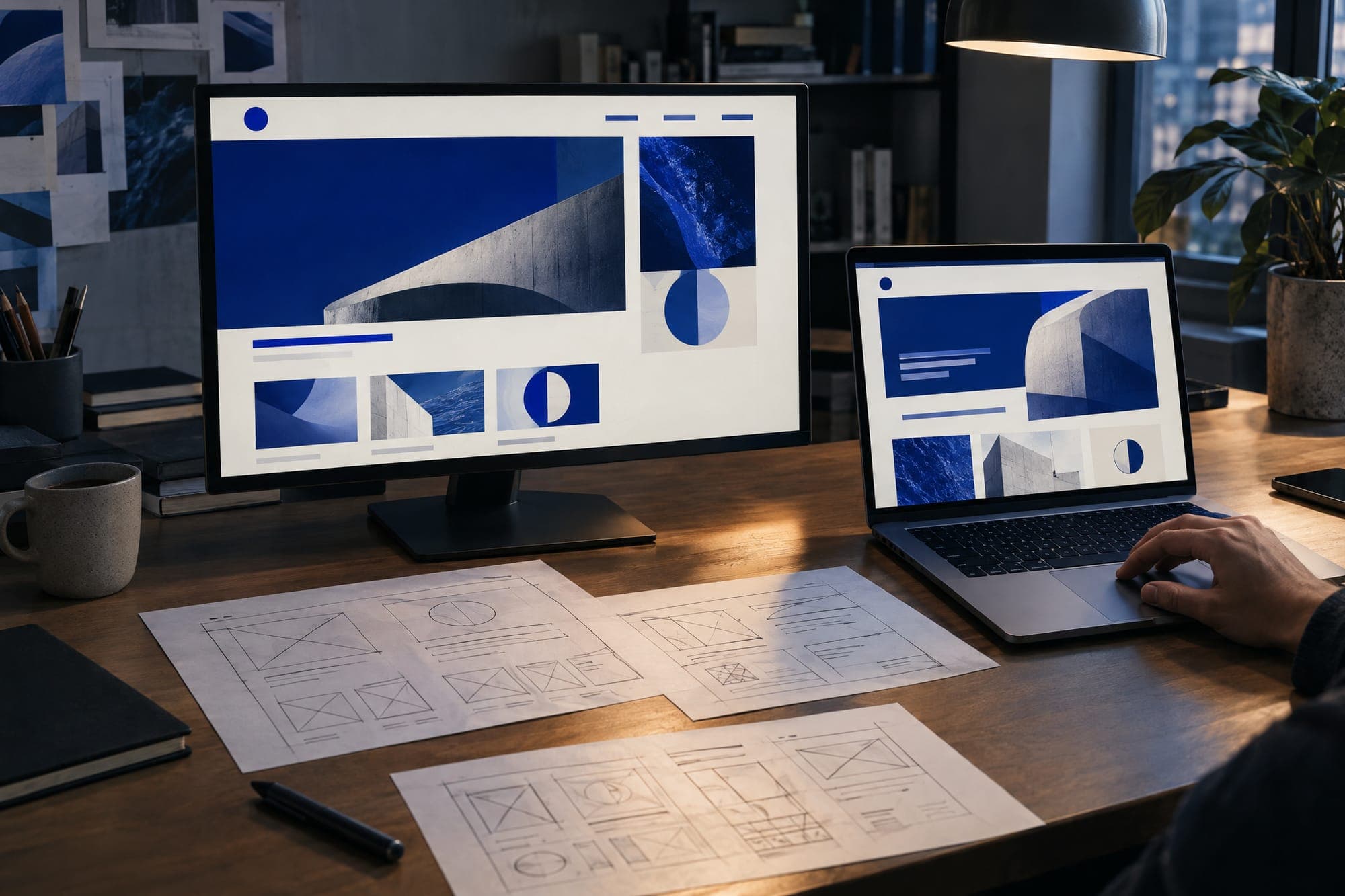
Bilingual website layouts in Arabic and English shown side by side on screen

What is Web design and development at AI-DARE?

AI-DARE's web design and development service plans, designs and builds bilingual Arabic and English websites for brands in Qatar and the GCC. Each site has a true right-to-left Arabic version, fast load times, technical SEO and structured data built in, and a content system your team can update without a developer.

What you get

  • Website strategy, sitemap and content structure planned in both languages
  • Bilingual UI design with mirrored right-to-left Arabic layouts and proper Arabic typography
  • Development on a modern stack with a content management system your team can edit
  • E-commerce with local payment options, delivery settings and Arabic product content
  • Technical SEO, structured data, Core Web Vitals performance, accessibility and analytics setup

How it moves

  1. 01

    Plan

    We define what the site must achieve, who uses it in each language, and what content exists. The output is a sitemap, key user flows and a content plan for Arabic and English.

  2. 02

    Design

    Key pages are designed in both directions at once, then prototyped so you can click through the real experience on your phone before a line of production code is written.

  3. 03

    Build

    We develop, connect the CMS, migrate content, set up redirects and test on real devices and browsers, in Arabic and English, against performance and accessibility targets.

  4. 04

    Launch and hand over

    We launch, submit sitemaps to search engines, watch errors and rankings in the first weeks, and train your team to run the site with confidence.

What should a bilingual Arabic and English website include?

A bilingual website needs a separate, indexable URL for each language, a fully mirrored right-to-left Arabic layout, Arabic typography chosen for screens, and Arabic content written for Arabic readers. It also needs hreflang tags, a language switch that keeps you on the same page, and forms, dates and numbers that work in both languages.

Mirroring is more than flipping text alignment. Navigation, icons that imply direction, sliders, progress bars, tables and breadcrumbs all reverse in Arabic, while phone numbers, product codes and some icons must not.

Arabic type usually needs a larger size and more line height than Latin to read comfortably, and Arabic web fonts are heavy, so we subset and load them carefully to keep pages fast.

The most common failure we see in the region is a beautiful English site with an Arabic version that was translated by machine and squeezed into the English layout. Search engines and Arabic readers both notice.

How do you build an e-commerce website in Qatar?

Start with operations, then design. Choose a platform that fits your catalogue size and team, connect a payment gateway that accepts the cards your customers actually use, set delivery zones and fees, and write product content in Arabic and English. Then design the store around fast mobile checkout, because most shoppers in the region buy on their phones.

Payments deserve early attention. Customers in Qatar expect to pay with local debit cards as well as international cards and wallets such as Apple Pay, and some still prefer cash on delivery. The gateway you choose decides which of these you can offer.

Selling across the GCC adds rules. Tax treatment, currencies, shipping and returns differ by country, and Saudi Arabia and the UAE apply VAT, so a regional store needs settings per market and an accountant's input.

Arabic product data is often the slowest part of a launch. We plan it as a content workstream with its own owner and schedule, not a translation job at the end.

Does website speed affect SEO and sales?

Yes. Google uses page experience signals, including Core Web Vitals, as part of how it evaluates pages, and slow pages lose visitors before they read anything. Speed matters most on mobile networks, which is how most people in Qatar and the GCC browse. We set performance budgets at the start and test against them before launch.

The usual culprits are oversized images and video, heavy Arabic fonts, too many third-party scripts and slow hosting far from the region. Each one has a known fix.

We serve images in modern formats at the right size, load fonts selectively, render pages on the server where it helps, and keep tracking scripts to the ones you actually use.

Which platform is best for a business website in Qatar?

The best platform is the one your team can run and the business can grow on. A brand site with rich content often suits a modern framework with a headless CMS. A store may suit Shopify or a similar commerce platform. WordPress still fits teams already trained on it. We recommend after understanding your content, integrations and team.

Check Arabic support before anything else. Some themes and plugins claim RTL support but break on real Arabic content, especially in checkout, search and email templates.

Think about integrations early: booking systems, CRM, ERP, payment gateways, WhatsApp and marketing tools. They shape the platform choice more than design does.

Questions, answered.

Can you redesign our website without losing Google rankings?

We plan every redesign to protect what already ranks. Before launch we crawl the old site, map every URL to its new address with permanent redirects, keep content that earns traffic, and carry over titles, structured data and internal links. After launch we monitor Search Console for errors. Some movement is normal, and nobody can promise rankings.

Do you write the Arabic content for the website?

Yes. Arabic copy is written as original Modern Standard Arabic for Arabic readers and Arabic search intent, not translated word for word from English. If you already have content, we edit it for clarity, tone and search, and we can work with your own reviewers. Every Arabic page is reviewed by a native speaker before it goes live.

Can our team update the website ourselves?

Yes. We set up the content management system so your team can edit pages, publish news, change images and manage products in both languages without touching code. Content types are designed around what you actually publish, with guardrails that keep the layout intact. We train your team at handover and leave a short written guide.

Will our website be accessible to people with disabilities?

We design and build to WCAG 2.2 level AA as our target: sufficient colour contrast, keyboard navigation, screen reader labels in both languages, captions for video and motion that respects reduced-motion settings. Accessibility also tends to improve SEO and usability for everyone, so we treat it as part of quality rather than an extra.

Does the website comply with data privacy rules in Qatar?

We build privacy in from the start: consent for cookies and tracking, clear privacy notices in Arabic and English, secure forms and minimal data collection. Qatar has a personal data protection law, Law No. 13 of 2016, and Saudi Arabia and the UAE have their own. Your legal adviser confirms the requirements, and we implement them.

What do we own when the website is finished?

Ownership and licences are written into the contract before work starts, so there is no ambiguity later. At handover you receive admin access to the CMS, hosting and analytics, the domain under your own account, design files and documentation. Third-party items such as fonts, plugins and stock images stay under their own licences.

Your safe idea has already been made.

Tell us the other one. A human replies on WhatsApp, fast, with one question back.